
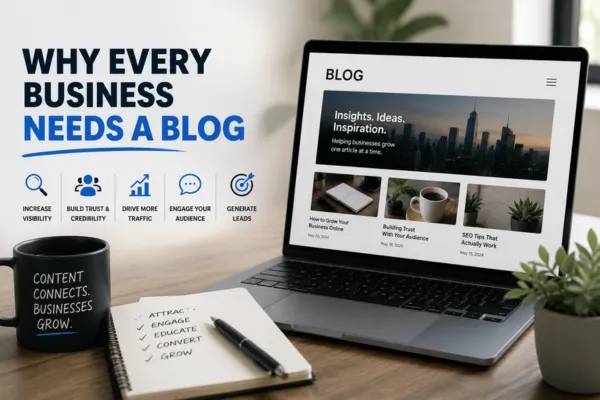
Why Every Business Needs a Blog for Growth
Marketing, Business Blogging, Content Strategy
Why Your Business Needs a Blog (Yes, Even Yours)
If your website is just a digital business card, this is your gentle, lovingly sarcastic intervention from Formosi. We’re here to tell you that your business needs a blog. Yes, yours. Even if you’re “too busy,” “too niche,” or “pretty sure Instagram is enough.”
Your Blog Is the Employee That Works 24/7
And never asks for a raise, just a publish button
Let’s Start with the Awkward Truth About Your Website
Your website is probably very polite. It says “About Us,” it lists your services, it maybe even smiles in stock-photo. But without business blogging, it’s also quietly invisible. Like a billboard in the desert. At night. Facing the wrong way. With the lights off.
Meanwhile, 68% of online experiences start with a search engine. People are literally typing in questions you could answer. Instead, they’re finding your competitor who wrote “7 Things to Know Before Hiring a Business Like Yours.” They’re getting the clicks, the leads, and the money. You’re getting… philosophical about whether blogs are “still a thing.”
The Numbers: Blogging Isn’t Cute, It’s Profitable
Let’s talk stats, because nothing says “I’m listening now” like percentages and the faint scent of FOMO:
Businesses that blog get 55% more website traffic than those that don’t. That’s not a rounding error; that’s a second internet showing up just for you.
Companies that prioritize business blogging are 13x more likely to see positive ROI. If your other marketing channels are starting to feel like a very expensive hobby, this matters.
Content marketing (which your blog is the backbone of) generates 3x more leads at 62% lower cost than traditional marketing. That’s like swapping a leaky marketing bucket for one that actually holds water. And champagne.
SEO leads close at around 14.6%, compared to 1.7% for outbound tactics. Translation: people who find you through your content are already halfway in love with you.
Also, blogging isn’t some fringe tactic. Around 80–90% of businesses now use blogs as part of their marketing strategy. But here’s the twist: only about 35% of small businesses have a blog at all. So if you’re small and blog-less, you’re not just behind — you’re leaving an entire channel of small business growth sitting on the table, waving sadly.

Businesses that blog see up to 55% more traffic and 67% more leads.
Example #1: The Neighborhood Coffee Shop That Accidentally Became Internet Famous
Meet Sara. She runs a cozy neighborhood coffee shop. Great latte art, loyal locals, one very judgmental tip jar. Her website used to be three pages: Home, Menu, Contact. Classic. Also, invisible in search results unless you typed her exact name and maybe her blood type.
Then she starts business blogging. Nothing wild — just one post a week:
“How to Brew Café-Level Coffee at Home (Without Selling a Kidney for Gear)”
“Cold Brew vs Iced Coffee: The Feud No One Asked For”
“5 Mistakes Ruining Your Morning Coffee (Yes, We’re Judging Your Kettle)”
Suddenly, people searching “how to make better coffee at home” find her. Website traffic climbs. Her online store — where she sells beans and brewing kits — starts getting orders from people who have never even been to her city. Her email list grows from “my mom and two regulars” to hundreds of subscribers getting her weekly coffee tips. That’s not just website traffic; that’s lead generation on autopilot.
💡 Pro Tip: You don’t need viral content. You need useful, searchable, consistent content. The internet rewards effort, not drama. Usually.

Even local shops can turn how-to posts into online sales and loyal fans.
Example #2: The Salon That Turned Hair Tips into Booked-Out Calendars
Now let’s talk about Mia, who runs a mid-size salon. Her biggest marketing move used to be posting the occasional before-and-after photo with the caption “Yasss 🔥” and hoping people would magically book online. (They did not magically book online.)
She starts a blog. Topics like:
“How to Make Your Color Last 3 Weeks Longer (Stylists Hate This One Trick… Kind Of)”
“Curly Hair Care 101: Stop Fighting Your Curls, They’re Winning”
“What to Ask Your Stylist Before a Big Hair Change (So You Don’t Cry Later)”
These posts start ranking for local SEO terms like “best salon for curly hair in [city]” and “how often should I get a trim.” Her traffic climbs. Her booking form — strategically placed at the end of each post — starts filling up. Because here’s the magic: B2B and B2C businesses with blogs generate around 67% more leads than those without. Mia’s not just posting; she’s printing future revenue in paragraph form.

Educational posts build trust, and trust quietly fills your appointment calendar.
Example #3: The Enterprise That Finally Stopped Sounding Like a Press Release
Now for the big kids: the multi-million-dollar enterprise. You’ve got a marketing team, a CRM, probably at least one person whose job title includes the words “synergy” or “enablement.” You also probably have a blog that’s 90% press releases and 10% “Our CEO Spoke at a Thing.”
When enterprise companies shift from announcements to actual insight — think “State of the Industry” breakdowns, “How We Solved X Problem for Y Client,” and “What This New Regulation Really Means for You” — the game changes. B2B brands with strong content and SEO strategies are seeing average 3-year ROI north of 700% from blogging and related content alone. That’s not just nice; that’s “please forward this to finance” nice.
Their blog becomes the place decision-makers go when they’re in research mode. And in B2B land, research mode is where deals are quietly won or lost long before a sales rep sends that “just bumping this to the top of your inbox” email.

Strategic blogs turn your website into a research hub that feeds your pipeline.
Why Blogging Supercharges Your SEO (Without Needing a PhD in Algorithms)
SEO can sound scary, like math that judges you. But at its core, it’s simple: search engines want to show the most helpful, relevant, trustworthy content. Business blogging is how you raise your hand and say, “Hi, that’s us. We’re helpful. We have charts.”
Companies that blog have 434% more indexed pages and 97% more inbound links. More pages = more chances to be found. More links = more authority. More authority = the algorithm stops side-eyeing you.
Educational posts (not just “company news”) can drive over 50% more organic traffic. Teach, don’t just talk about yourself. It works in real life; it works online.
And remember: 96.6% of web pages get zero organic traffic. Your job isn’t to publish more random pages. It’s to publish the right pages: strategic, keyword-informed, actually-useful blog posts that answer real questions your customers are already asking.

Strategic blog content helps you show up exactly when buyers start searching.
“But We Don’t Have Time” and Other Adorable Objections
Let’s address the greatest hits:
“We don’t have time.” Totally fair. Also: you’re already spending time answering the same questions in emails, DMs, and calls. Blogging turns those answers into assets that work 24/7. Answer once, benefit hundreds of times. Very efficient. Very attractive.
“No one would read our blog.” People read 2,000-word breakdowns of toaster reviews. They will absolutely read “How to Choose the Right Accountant for Your Small Business” if they’re panicking about taxes at 11:47 p.m.
“Our industry is boring.” Perfect. Boring industries make the best blogs because no one else is explaining anything clearly. Be the one brand that does, and you win the search results, the trust, and probably the revenue.
📌 Key Takeaway: Your blog is not about being entertaining for the entire internet. It’s about being incredibly useful to the specific people who might actually pay you.
The Compounding Magic: Why Your Blog Gets More Valuable Over Time
Here’s the part no one tells you because it doesn’t sound sexy on a billboard: blogging is a compounding asset. The first few months? It might feel slow. But over 12–18 months, those posts stack. They rank for more keywords. They get shared. They attract links. They keep generating leads long after you’ve forgotten you wrote them.
Across industries, content marketing programs commonly see 3–5x ROI within a year, with elite programs hitting 6–10x or more. Blogging specifically has been measured at over 300% ROI in year one and climbing from there. Compare that to ads, where the second you stop paying, everything stops working. Your blog is more like buying a rental property. Your ads are more like renting a hotel room by the hour. We’ll let that visual sit with you.
So… What Does a Formosi-Approved Blog Strategy Look Like?
We’re glad you asked, hypothetical but increasingly interested reader. At Formosi, we help you build a blogging strategy that isn’t just “post vibes, hope for clicks.” We focus on:
Clear goals: More website traffic, more qualified leads, better SEO, or all of the above. (We’re fond of “all of the above.”)
SEO-informed topics: We find what your customers are actually searching for and build content around that, not just “things we felt like saying on a Tuesday.”
Lead paths: Every post has a next step — book a call, download a guide, join a list, buy the thing. Blog benefits are nice; booked revenue is nicer.
Repurposing: One great blog can become social posts, email content, sales enablement material, and more. It’s the content version of leftovers that somehow taste better the next day.
Ready for the Gentle Roast: Why Haven’t You Started Yet?
If you’ve made it this far, you already know the answer to “do we really need a blog?” It’s yes. It’s been yes for a while. The longer you wait, the more your competitors quietly stack traffic, leads, and brand authority while you bravely refresh your homepage copy for the fifth time this year.
Whether you’re:
A local coffee shop who could be shipping beans nationwide with the right brewing guides,
A salon or service business that could turn how-to advice into fully booked calendars,
Or a large enterprise that should be owning the conversation in your industry instead of watching from the sidelines,
…business blogging is no longer optional. It’s infrastructure. Like electricity. Or Wi‑Fi. Or that one employee who knows all the passwords.
Your Next Step (Spoiler: It’s Easier Than You Think)
Here’s the part where we make this painfully easy. If you’re ready to turn your website into a lead-generating, SEO-loving, revenue-supporting machine, Formosi can help you build and run a blog strategy that actually works — without you having to become a full-time writer, SEO nerd, or analytics whisperer. That’s our job. We’re disturbingly into it.
We’ll work with you to:
Identify the topics your customers are already searching for,
Create content that sounds like you (on your best day, after coffee),
Optimize for SEO so your posts actually get found, not just “exist,”
And plug every post into your broader content marketing and lead generation systems.
If you’re ready to stop treating your website like a static brochure and start treating it like the hardest-working member of your sales team, reach out to Formosi today. We’ll help you plan, write, and launch a blog that drives real website traffic, real leads, and real revenue — with a side of wit, strategy, and just enough gentle roasting to keep things interesting.
Click that contact button, send the email, book the call — whatever your preferred method of commitment is. Your future customers are already searching. It’s time your business actually shows up.
SEO Title: Why Your Business Needs a Blog (Yes, Even Yours) | Formosi Agency
Meta Description: Discover why business blogging is essential for small shops and large enterprises alike. Learn how blogs boost SEO, website traffic, and lead generation — and how Formosi can build a blog strategy that actually drives ROI.
Meta Keywords: business blogging, blog benefits, SEO, lead generation, content marketing, small business growth, website traffic, Formosi agency